Understanding Anxiety
How to Record the Sequence of Worry Leading to Physical Hyperarousal
Anxiety changes not only thoughts but also heart rate, breathing, muscles, gastrointestinal function, and sleep, narrowing one's daily life through avoidance. Baekrokdam identifies the earliest physical reactions and the slowest-recovering discomforts to treat both hyperarousal and the restricted scope of daily activities.
Simply saying you have a lot of worries makes it difficult to explain the process of heart racing, shallow breathing, a blocked feeling in the solar plexus, and restless sleep. By knowing where the body's alarm starts, how it grows, and how slowly it turns off, specific goals for Korean herbal medicine and acupuncture treatment can be set. The starting point of treatment is to change both the peak height of the alarm and the recovery time, rather than simply increasing the strength to endure it.
| Scenario to Distinguish | Details to Record | Next Question |
|---|---|---|
| Initial changes | Start date, medication, illness, or events | Was there another cause first? |
| Long-term recurring discomfort | Frequency, recovery time, and avoided activities | What is the biggest obstacle in your daily life? |
| Changes during treatment or dosage reduction | Dosage changes, new symptoms, or function | Does the plan need to be adjusted? |
Please describe the sequence in which your throbbing and anxiety begin
Anxiety is a state where the body, anticipating danger, simultaneously alters heart rate, breathing, muscle tension, sweating, and gastrointestinal movement. Some people experience a racing heart first, followed by the thought that 'something is wrong,' while others experience a tightening in the solar plexus and throat after prolonged worry.
Knowing which comes first allows us to treat the sequence of the body's escalating alarm without dismissing all throbbing as being solely due to the mind. The key is not the act of recording itself, but identifying where the alarm starts and how it restricts your daily life.
Distinguish whether it spikes suddenly or worsens as tension builds up
If shortness of breath, a racing heart, and terror reach a peak within a few minutes, it is closer to a panic attack; if prolonged worry about various matters leads to tension in the shoulders, jaw, and solar plexus along with insomnia, there is a higher proportion of hyperarousalpersistent anxiety. When both overlap, a small change can trigger an attack while the body is already in a heightened state of alarm.
Even if the frequency of attacks decreases, avoidance remains if you continue to avoid the subway, driving, or going out alone. Treatment must recover not only the intensity of the moment but also the ability to remain present when anxiety rises and the range of activities you can resume.
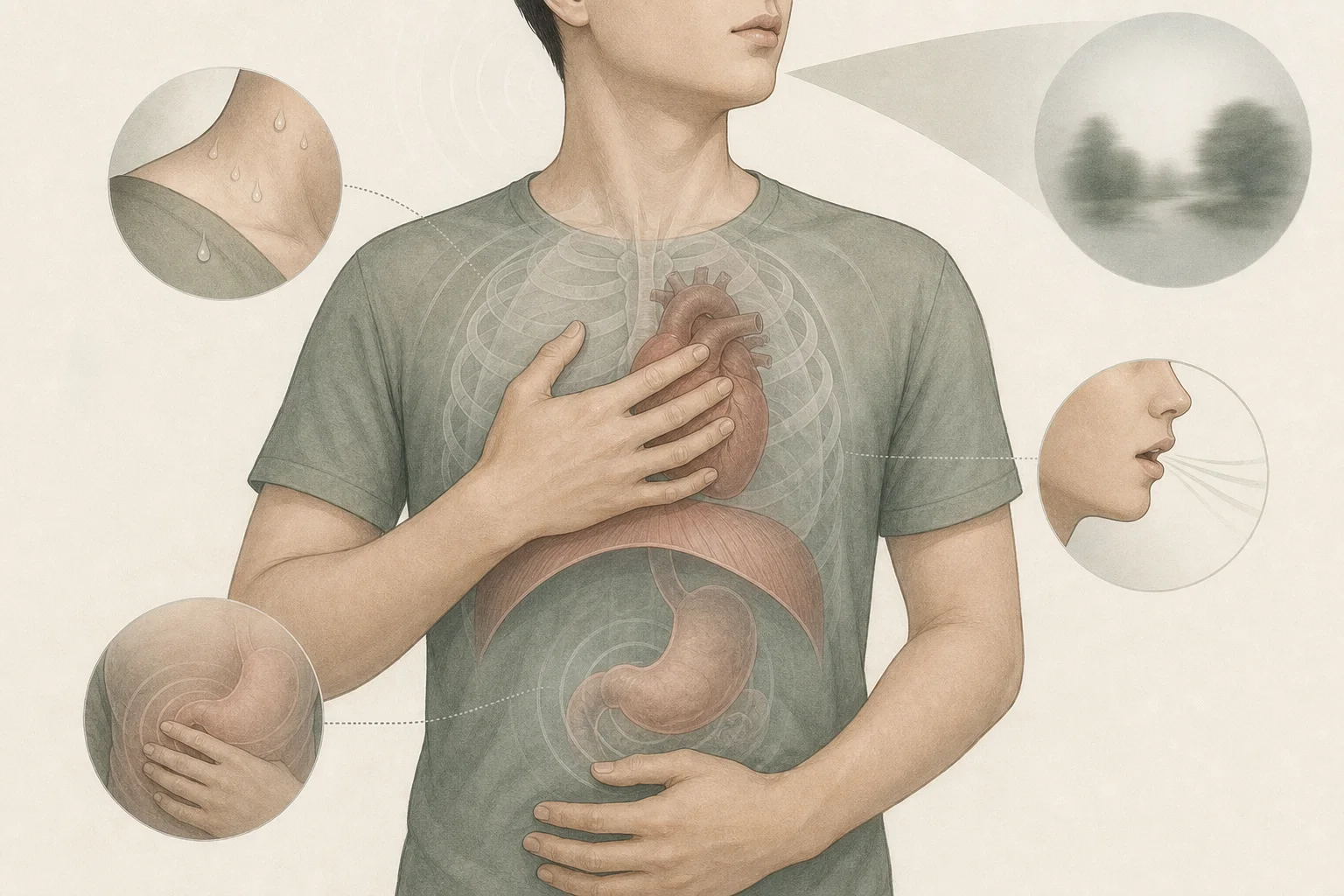
The physical symptoms felt during an attack are real. If new chest pain or fainting occurs, the causes related to the heart and respiratory system should be checked first.
New chest pain or fainting is not dismissed as mere anxiety
New chest pain, fainting, irregular heartbeat that worsens during exercise, weakness on one side of the body, or changes in speech must be re-evaluated, even if they seem similar to previous panic attacks. We also check for causes that trigger the body's alarm, such as thyroid issues, anemia, hypoglycemia, medications, or caffeine, in relation to current symptoms.
Even if throbbing, breathing, or gastrointestinal discomfort persists after the necessary evaluations, it does not mean the symptoms are fake. We can now treat the process by which the body's alarm is easily triggered and slow to turn off.
In Korean medicine treatment, we examine the recurring flow of bodily tension
Baekrokdam does not group the following as the same type of anxiety: those with a racing heart accompanied by facial flushing and spikes of sweat; those with a blocked solar plexus followed by nausea and diarrhea; and those whose thoughts and muscle tension do not relax before sleep. Korean herbal medicine treatment is formulated based on the first reaction to appear and the discomfort that lasts the longest.
Acupuncture treatment helps the body exit the alarm state by lowering tension in the neck, chest, and solar plexus, and stabilizing the breathing rhythm. While respecting existing psychotherapy and medication, we concurrently address the points where physical discomfort makes it difficult to sustain treatment.
Prepare this information so it can be reviewed promptly at your next visit
Improving does not mean that worries disappear completely. It means that throbbing does not spike to its peak, the time it takes to subside becomes shorter even when it does rise, and you can once again choose to engage in the travel and meetings you previously avoided.
You do not need to observe every single moment. Comparing the starting point, peak, and the activities that became possible after recovery from one representative attack and one day of prolonged tension provides sufficient information for the next Korean herbal medicine prescription and lifestyle adjustments.
When the body feels comfortable first, your capacity to manage anxiety also changes
When the heart races and the solar plexus feels blocked before sleep, the body's alarm continues to send danger signals even if you try to change your thoughts. If the onset of sleep and the tension in breathing and digestion are eased first through Korean herbal medicine and acupuncture, you may find the mental space to remain present without immediately avoiding the moment when anxiety rises.
Baekrokdam does not only ask for an 'anxiety score.' We look at whether the time it takes to fall back asleep at night has decreased, whether you are skipping meals, and to what extent you are choosing to return to situations you once avoided, such as public transportation or meetings. Treatment is truly integrated into daily life when physical recovery leads to choices in your lifestyle.
The treatment of anxiety does not stop at simply halting thoughts. By distinguishing between the reactions where the body's alarm first appears and the discomfort that is slow to recover, we use Korean herbal medicine and acupuncture to lower the intensity and duration of these alarms, gradually expanding the daily life you once avoided.
Evidence and Update Information
This content was organized by Korean medicine doctor Choi Yeon-seung and was updated on 2026-08-26.
- NIMH: Anxiety DisordersBasic explanations of generalized anxiety, panic, social anxiety, and difficulties experienced in daily life
- WHO: Anxiety disordersPhysical, cognitive, and behavioral symptoms of anxiety disorders, daily difficulties, and the role of psychotherapy
- NIMH: Panic Disorder: What You Need to KnowPhysical symptoms of panic attacks, avoidance, and comorbid conditions
- NICE CG113: Generalised anxiety disorder and panic disorderStep-by-step evaluation of generalized anxiety and panic, and recommendations for psychological and pharmacological treatment
- NICE CG159: Social anxiety disorderEvaluation of social anxiety and treatment principles centered on cognitive behavioral therapy
- VA/DoD 2025: Chronic Insomnia Disorder and Obstructive Sleep ApneaAssessment and treatment of chronic insomnia and sleep apnea, and the CBT-I priority principle
- PubMed: Acupuncture for Anxiety, systematic review and meta-analysisA comprehensive review of acupuncture research for anxiety, including verification of research heterogeneity and application limits
- NICE NG215: Medicines associated with dependence or withdrawal symptomsGradual reduction of benzodiazepines, Z-drugs, antidepressants, etc., and principles of individual pacing and continuous observation
- NIMH: DepressionEmotional, cognitive, and physical symptoms of depression and when to seek help