Anxiety Differential Diagnosis
When Hwabyung, Panic, and Menopausal Heat Flushes Overlap
These three conditions can overlap. Rather than fitting them into a single label, distinguishing the sequence in which symptoms appear and the body's underlying constitution makes it clear where herbal medicine treatment should begin.
While facial flushing, racing heart, and shortness of breath may feel similar, HwabyungHwabyung is centered on accumulated resentment and stagnation, panic is characterized by sudden fear attacks, and menopausal heat flushes center on menstrual changes and vasomotor symptoms.
| Condition to Distinguish | How symptoms manifest | Key indicators |
|---|---|---|
| Hwabyung | Accumulates in the chest, surges upward, and causes a feeling of a blocked throat | Long-suppressed feelings of unfairness, anger, and sighing |
| Panic Attack | Fear and physical symptoms surge within minutes without warning | Avoiding places and activities due to fear of recurrence |
| Menopausal heat sensations | Heat suddenly spreads to the face and upper body, accompanied by sweating | Menstrual changes, night sweats, and sleep changes |
| Overlapping conditions | Heat sensations and throbbing are followed by anxiety and insomnia, which amplify each other | What started first and what persists the longest |
Even if it is the same sensation of heat, the context of how it begins differs
The heat associated with Hwabyung (anger syndrome) usually does not appear overnight. It is common for a person to endure unfair or frustrating situations for a long time, leading to a feeling of chest tightness, increased sighing, and a sensation of a lump in the throat or solar plexus, followed by heat surging upward. In contrast, with panic, heart racing, shortness of breath, and a fear of dying can peak within minutes, even during relatively calm moments.
Menopausal heat flashes often involve a sudden spread of heat and sweating in the face, neck, and upper chest, frequently coinciding with fluctuations in the menstrual cycle. However, these three patterns can overlap, for example, poor sleep during menopause may exacerbate panic, or long-suppressed emotions may surface more strongly during the menopausal transition.
Hwabyung is not just a matter of emotion, but a state of stagnation remaining in the body
If Hwabyung is viewed simply as a 'hot-tempered personality,' the long period of endurance the patient went through is overlooked. It is closer to a state where unexpressed anger and resentment have repeated, causing chest tightness, surging heat, heat flashes, dry mouth, throbbing, digestive discomfort, and insomnia to harden into a single mass. This is why physical symptoms are not resolved simply by explaining the emotions.
In treatment, we examine whether conflicts are still ongoing, whether the body remains in a state of alert even after the event has ended, whether exhaustion follows the surge of heat, and whether the tightness interferes with eating and sleeping. Identifying this sequence determines whether to resolve the stagnation, lower the surging heat, or supplement long-depleted Qi and blood.
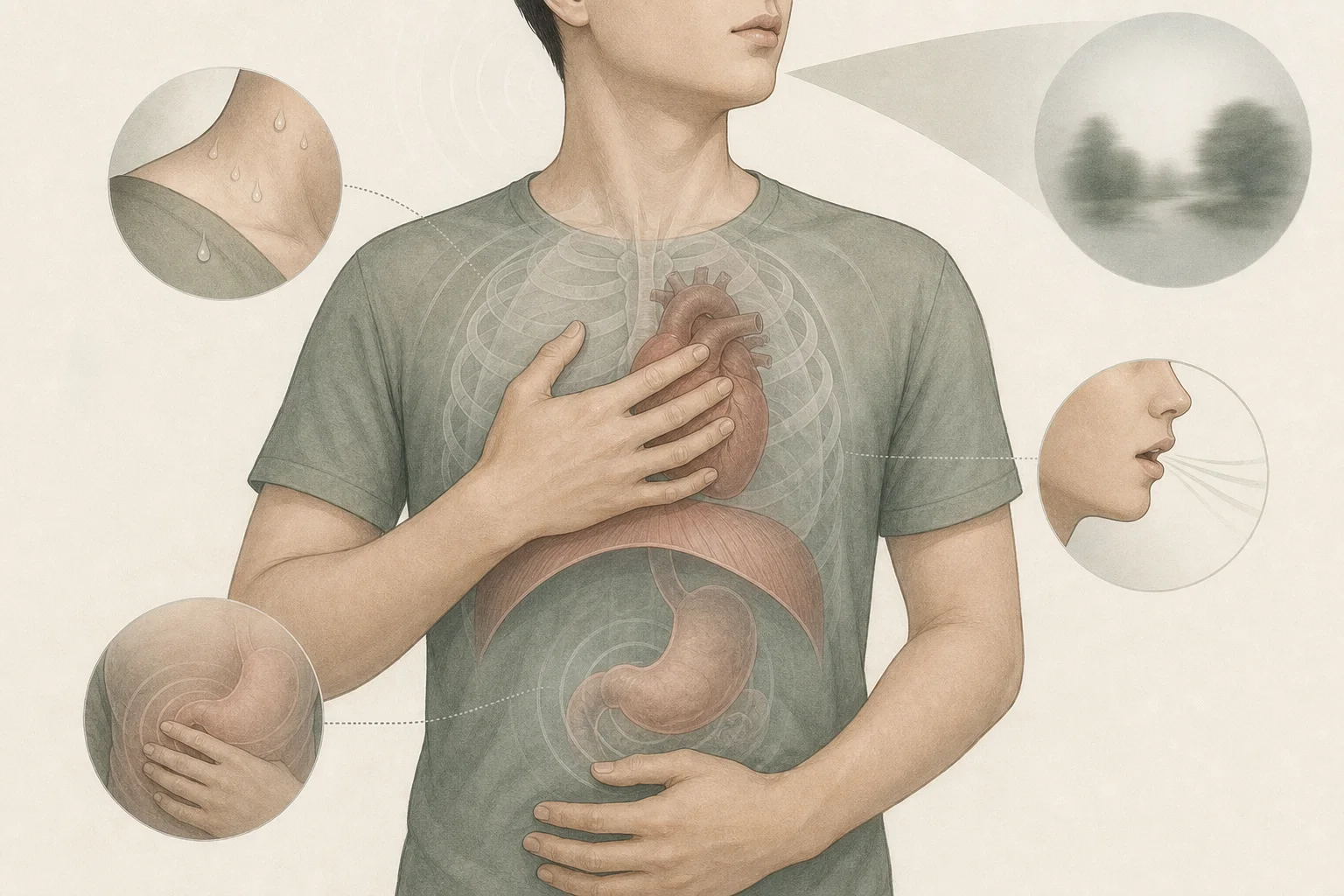
The physical symptoms felt during an attack are real. If new chest pain or fainting occurs, the causes related to the heart and respiratory system should be checked first.
Panic requires treating the fear that remains after the attack has passed
A panic attack brings a sudden rush of increased heart rate, shortness of breath, tremors, cold sweats, dizziness, and a feeling of detachment from reality. Even after the attack itself subsides, anticipatory anxiety, the fear of 'what if it happens again', remains, leading the person to avoid situations that increase heart rate, such as driving, taking the subway, going out alone, or exercising. Whether this avoidance expands is a critical point that distinguishes it from a simple one-time shock Panic Disorderand is a key diagnostic marker.
Strong chest pain experienced for the first time, fainting, symptoms occurring during exercise, weakness on one side of the body, or changes in speech are not immediately concluded as panic. If attacks and avoidance persist even after necessary cardiac, neurological, and thyroid evaluations, we treat the body's hyperarousalphysical response and the cycle of anxiety together.
In menopause, it is not only heat flashes but also nighttime recovery that is disrupted
Representative vasomotor symptoms of menopause include sudden heat and sweating spreading to the upper body and face. Frequent waking due to night sweats increases daytime fatigue and irritability, making it easier for anxiety to attach to throbbing sensations that were previously ignored. If changes in menstrual intervals and volume, vaginal dryness, joint discomfort, and memory decline began around the same time, we consider the broader context of menopause.
Conversely, if your chest feels blocked and heat rises after a specific conflict regardless of menstrual changes, or if fear rapidly reaches a peak without a clear trigger, it is difficult to explain these symptoms as menopausal hot flashes alone. When these three symptoms overlap, it is necessary to consider the relative contribution of each rather than dismissing any one of them as imaginary.
Korean medicine treatment addresses both the surging force and the depleted foundation
At Baekrokdam, we do not simply suppress the single symptom of heat with cooling agents. We vary the Korean herbal medicine prescriptions based on the sequence of manifestation in the body: Gan-ul-hwa-hwa (liver qi stagnation transforming into fire) where Qi is blocked by resentment and tension and surges upward; Dam-gi-ul-gyeol (phlegm-qi stagnation) where phlegm accumulates in the chest and throat, increasing tightness and fear; and Eum-heo-hwa-wang (yin deficiency leading to fire) where a lack of yin after menopause causes nighttime heat and sweating.
Acupuncture is used to reduce tension in the chest and throat and lower excessive sympathetic nervous system responses, while Korean herbal medicine is tailored to regulate heat flashes, throbbing, insomnia, and digestive discomfort together to shorten the recovery time after an attack. If you are currently taking psychiatric medication or menopause treatment, we do not demand immediate discontinuation but rather increase the body's stability first while continuing them in parallel.
Recovery begins not with a state where heat never occurs, but where the fluctuations become smaller
Lifestyle management is also not applied identically to the three states. For Hwabyung, rather than advice to endure again, it is necessary to set boundaries for conflict and create a channel to release the body's tightness. For panic, rather than avoiding all situations that increase heart rate, one should gradually reclaim daily life within the framework of treatment. For menopausal heat flashes, it helps to reduce stimuli that clearly worsen the condition, such as excessive drinking, excessive caffeine, or overly hot environments, and to protect nighttime sleep.
When treatment is effective, the peak of the heat flashes lowers, the tightness in the chest and throat lasts for a shorter time, and the time to return to daily life after an attack decreases. Actual recovery, as viewed by Baekrokdam, is when sleep and digestion stabilize and the patient can resume activities they were avoiding.
Hwabyung, panic, and menopausal heat flashes can overlap, but by distinguishing the accumulation of emotion, the speed of the attack, and the patterns of menstruation and night sweats, the starting point for Korean herbal medicine treatment changes.
Evidence and Update Information
This content was organized by Korean medicine doctor Choi Yeon-seung based on the materials below and was updated on 2026-08-31.
- National Institute on Aging: What Is Menopause?Heat flashes, night sweats, and changes in sleep and mood during the menopausal transition
- PMC: A Review of the Korean Cultural Syndrome Hwa-ByungThe emotional context of Hwabyung (anger syndrome) and physical symptoms such as chest tightness, heat sensations, throbbing, and digestive discomfort
- NIMH: Anxiety DisordersBasic explanations of generalized anxiety, panic, social anxiety, and difficulties experienced in daily life
- WHO: Anxiety disordersPhysical, cognitive, and behavioral symptoms of anxiety disorders, daily difficulties, and the role of psychotherapy
- NIMH: Panic Disorder: What You Need to KnowPhysical symptoms of panic attacks, avoidance, and comorbid conditions
- NICE CG113: Generalised anxiety disorder and panic disorderStep-by-step evaluation of generalized anxiety and panic, and recommendations for psychological and pharmacological treatment
- NICE CG159: Social anxiety disorderEvaluation of social anxiety and treatment principles centered on cognitive behavioral therapy
- VA/DoD 2025: Chronic Insomnia Disorder and Obstructive Sleep ApneaAssessment and treatment of chronic insomnia and sleep apnea, and the CBT-I priority principle
- PubMed: Acupuncture for Anxiety, systematic review and meta-analysisA comprehensive review of acupuncture research for anxiety, including verification of research heterogeneity and application limits
- NICE NG215: Medicines associated with dependence or withdrawal symptomsGradual reduction of benzodiazepines, Z-drugs, antidepressants, etc., and principles of individual pacing and continuous observation
- NIMH: DepressionEmotional, cognitive, and physical symptoms of depression and when to seek help