Days of the Week and Sleep Rhythm
How to Restore Your Weekend Rhythm When Sunday Night Insomnia Ruins Your Monday
Weekend rhythm issues (where you sleep relatively well if you go to bed late and wake up late), sleep deprivation (where sleep time is simply too short), and insomnia (where it is difficult to fall or stay asleep even with sufficient time) all have different starting points. After identifying your specific pattern, we determine the order of lifestyle adjustments and medical evaluation.
First, determine whether your sleep onset is delayed only on Sunday nights, whether you generally lack opportunities to sleep, or whether you cannot fall asleep even when you have enough time. If it is a weekend rhythm issue, start by adjusting your wake-up time on Saturday; if sleep is difficult even on weekdays sleep deprivationor examine the patterns of chronic insomnia together.
| Category to choose first | Symptoms to check | First step |
|---|---|---|
| Weekend rhythm issues | Sleeps relatively well when going to bed late and waking up late on weekends | Align Saturday wake-up time, morning light exposure, and naps closer to weekday habits |
| Sleep Deprivation | Actual sleep time is short due to work, childcare, or daily schedules | First, secure opportunities for sleep and observe if daytime functioning recovers |
| Insomnia patterns | Difficulty falling asleep or frequent waking even on weekdays, despite having enough time | Check for bed-related tension and other sleep issues during a medical evaluation |
| When prompt confirmation is needed | Overlapping snoring, sleep apnea, severe daytime sleepiness, or drowsy driving | Undergo the relevant evaluation first rather than viewing it solely as a day-of-the-week issue |
First, we divide Sunday night issues into three categories
If you sleep and wake at set times during the week, but both bedtime and wake-up time are delayed on weekends, and you sleep relatively soundly on days you can stay up late, the influence of your weekly rhythm is significant. On the other hand, if your total sleep time is short due to work, childcare, or late schedules, and you fall asleep easily and resolve daytime sleepiness when given the chance, sleep deprivation must be addressed first.
If you have difficulty falling asleep or wake frequently on both weekdays and weekends despite allowing enough time for sleep, and tension persists when lying down despite being tired, we examine the pattern of chronic insomnia. If this overlaps with loud snoring, sleep apnea, severe daytime sleepiness, or drowsy driving, do not consider it merely Sunday insomnia and seek the relevant medical evaluation first.
Sunday night's sleep is created starting from Saturday morning
If you wake up three to four hours later than on weekdays and take long naps into the afternoon over the weekend, you may not build up enough sleep pressure to fall asleep on Sunday night. While the choice to rest because you are tired is not wrong, excessively long compensatory sleep creates a cycle that further delays falling asleep on Sunday.
Keep weekend wake-up times within two hours of weekday times, and avoid late afternoon naps if a nap is necessary. Rather than forcing yourself to lie down early only on Sunday night, aligning morning light, meals, and activity times closer to your weekday routine sleep rhythmis more practical for resetting your rhythm.
- Keep Saturday and Sunday wake-up times within two hours of weekdays
- Ensure naps do not extend long into the late afternoon
- Establish a starting point for the day with morning light, the first meal, and light activity
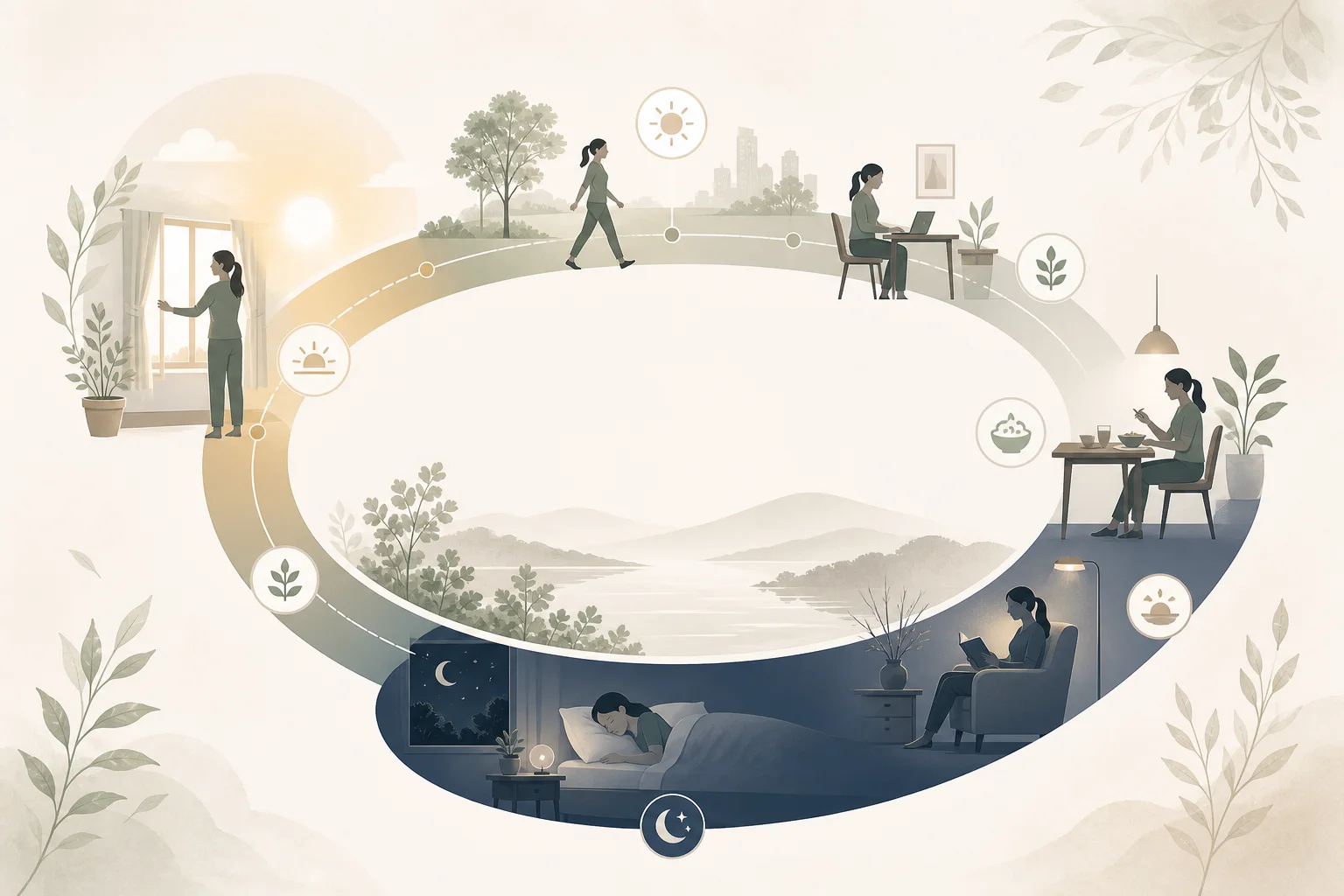
Rather than forcing yourself to lie down early, we adjust the wake-up time and the reference points for light, meals, and activity together.
It is better to go to bed when you are sleepy than to lie down early
If you lie in bed from Sunday evening because you are worried about Monday, the time spent awake increases, and anxiety such as 'What if I can't sleep today too?' can grow. The time spent struggling to force sleep actually links the bed with alertness.
Lower the lighting and reduce stimulating work until your usual bedtime, but go to bed only when you actually feel sleepy. If sleep does not come, it is better to engage in a short, monotonous activity outside of bed rather than constantly checking the clock or mentally rehearsing Monday's schedule.
You must release physical tension that arises before thoughts of Monday
Sunday night insomnia may not be a problem of schedule anxiety alone. Physical symptoms such as chest tightness, pulsating sensations, pressure in the solar plexus, and heat rising to the face hyperarousalIf this starts first, it is difficult to fall asleep simply by following advice to stop thinking.
Close your work screens an hour before bed and create simple signals for your body to transition into the night, such as a warm shower, slow breathing, and dim lighting. Since afternoon caffeine, late-night drinking, and late-night snacks can disrupt both hyperarousal and digestion, it is especially advisable to avoid combining these on Sundays.
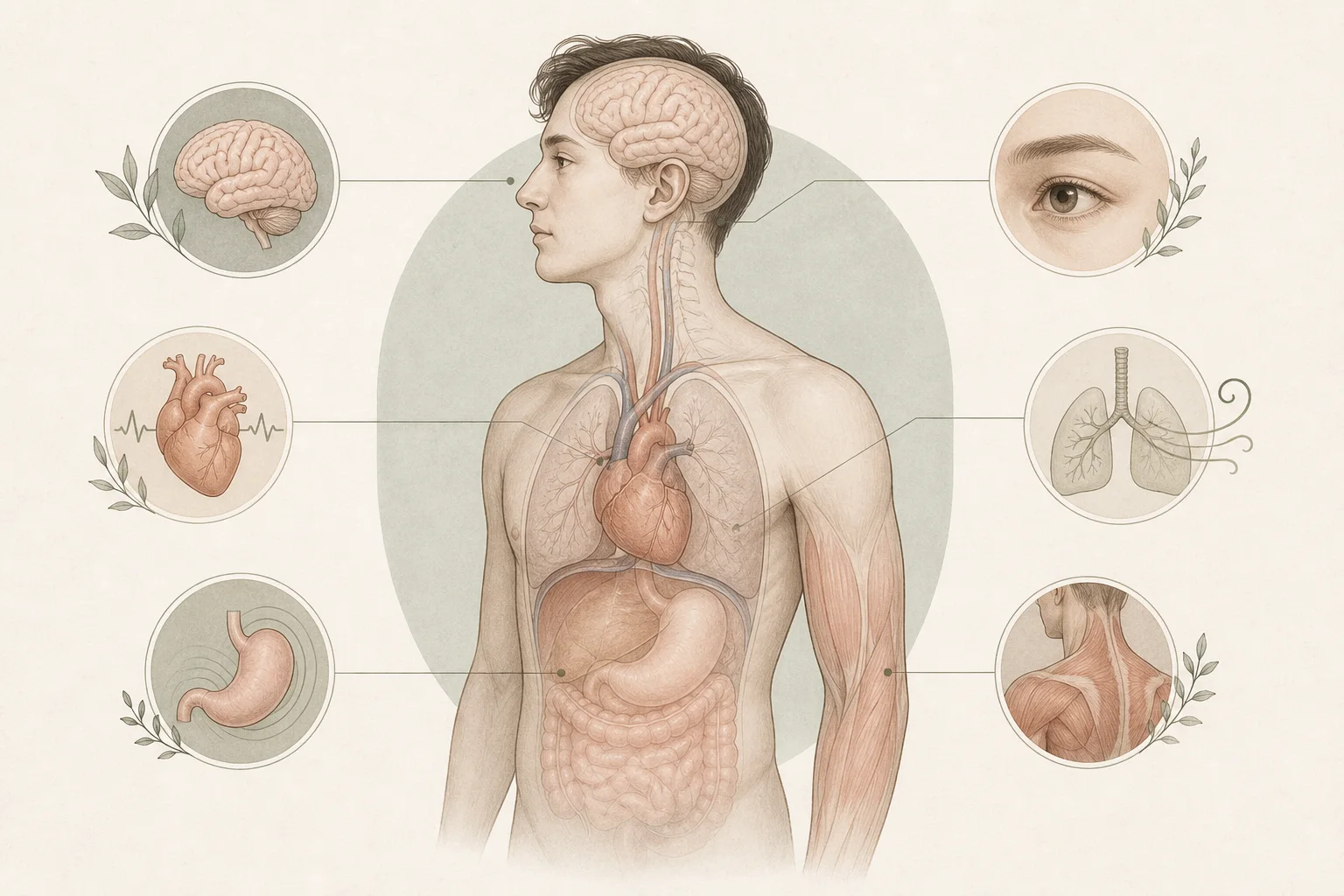
Hyperarousal is a physical response, but a single illustration is not used to diagnose all causes.
Korean medicine treatment addresses not only Sunday sleep onset but also the body's condition on Monday
Baekrokdam prescribes Korean herbal medicine by examining how a combination of overactive thoughts before bed, tension in the chest and solar plexus, body heat, digestion, and weekend rhythms create insomnia. Rather than simply aiming to induce sleep, we set the order of treatment so that the body's alarm system lowers at night.
Acupuncture treatment is provided in parallel to lower tension in the neck, chest, and breathing, helping the body transition into relaxation. We evaluate the treatment response not only by what time you fell asleep on Sunday, but also by how much less your energy, focus, and anxiety collapse on Monday morning.
If you have difficulty falling asleep or experience repeated early morning awakenings during the week as well, we treat it as a general pattern of chronic insomnia rather than isolating it as 'Sunday insomnia'.
The goal is not a perfect Sunday night, but a week where you feel less depleted through Monday
If your chest and solar plexus feel blocked, your thoughts won't stop, and your Monday routine collapses every Sunday despite adjusting your weekend rhythm, do not try to force sleep through willpower alone. It is better to divide the tasks between adjusting sleep habits and the role of Korean herbal medicine and acupuncture treatments.
Improvement does not necessarily mean sleeping exactly eight hours on Sunday. It means the burden of falling asleep is reduced, and even if your sleep is disrupted once, your capacity to maintain waking, eating, and working on Monday expands.
First, distinguish whether you sleep well if you go to bed late and wake up late, whether the opportunity for sleep itself is too short, or whether you have difficulty falling asleep even when you have enough time. Adjust your weekend rhythm starting from your Saturday wake-up time, and expand the scope of medical evaluation if insomnia or other sleep problems persist during the week.
Evidence and Update Information
Dr. Choi Yeon-seung, KMD, composed this based on the following materials and updated the content on 2026-09-02.
- NHLBI: InsomniaBasic explanation of insomnia, looking at both difficulty falling asleep and decreased functioning the next day
- NHLBI: Sleep deprivation and deficiencyThe impact of sleep deprivation and weekend compensatory sleep on daily functioning
- VA/DoD 2025: Chronic Insomnia Disorder and Obstructive Sleep ApneaOfficial clinical criteria for chronic insomnia evaluation, behavioral therapy, and treatment selection
- CDC: About sleepPublic health guidance on regular sleep timing and healthy sleep habits
- NHS: InsomniaLifestyle guidelines for patients to adjust caffeine, naps, and bedtime habits