Anxiety Differential Diagnosis
What do Panic Disorder, Agoraphobia, and Social Anxiety Fear? The Difference Between Fear of Attacks, Escape, and Evaluation
If you only look at which places are avoided, these three types of anxiety overlap. However, by distinguishing what is most feared, when physical attacks begin, and how far the avoidance has spread, the goals for psychological, pharmacological, and Korean medicine treatments become clear.
While avoiding subways, elevators, or crowded places may look the same, those with panic disorder fear another attack, Agoraphobiafear situations where it is difficult to escape or receive help, while social anxiety involves worrying about others' evaluations and embarrassment.
| Category | Greatest Fear | Manifestation in Daily Life |
|---|---|---|
| Panic Disorder | Unpredictable spikes of panic attacks and loss of control | Reducing activities due to fear of experiencing heart palpitations or shortness of breath again |
| Agoraphobia | Situations where it is difficult to escape or receive help | Avoiding public transportation, lines, wide or enclosed spaces, or going out alone |
| Social Anxiety | Being embarrassed or evaluated negatively | Avoiding situations where attention is focused, such as presentations, meals, conversations, or being the center of attention |
| Treatment Goal | Not focused solely on completely eliminating anxiety | Accelerating recovery after an attack and restoring the range of movement and social interaction |
Even if the same place is avoided, the core of the fear is different
Someone who worries about suffocating on the subway, someone who fears the fact that they cannot leave after the doors close, and someone who is afraid of trembling or collapsing in front of others may all avoid the subway. This is why surveys that only ask about the location cannot determine the direction of treatment.
Panic attackDepending on whether the greatest fear is the recurrence of symptoms, the difficulty of escape and receiving help, or the evaluation of others, the method of exposure, medication, and the physical responses addressed by Korean medicine treatment will differ. These three states can appear together, but they are not lumped together under one name.
In panic disorder, the body's alarm suddenly spikes to its peak
Even without a clear danger, the heart beats rapidly, breathing becomes difficult, limbs tingle, and a fear of dying or losing control grows within a few minutes. A single panic attack alone Panic Disorderdoes not make it a disorder; it becomes a problem for one's entire life when attacks recur and are followed by worry about the next attack and changes in behavior.
If attacks occur at night or in situations that are difficult to avoid, such as driving or meetings, one begins to distance themselves from those situations. Rather than simply suppressing the momentary throbbing, treatment addresses the peak height of the attack, the time it takes to subside, and the usual state of tension while waiting for the next attack.
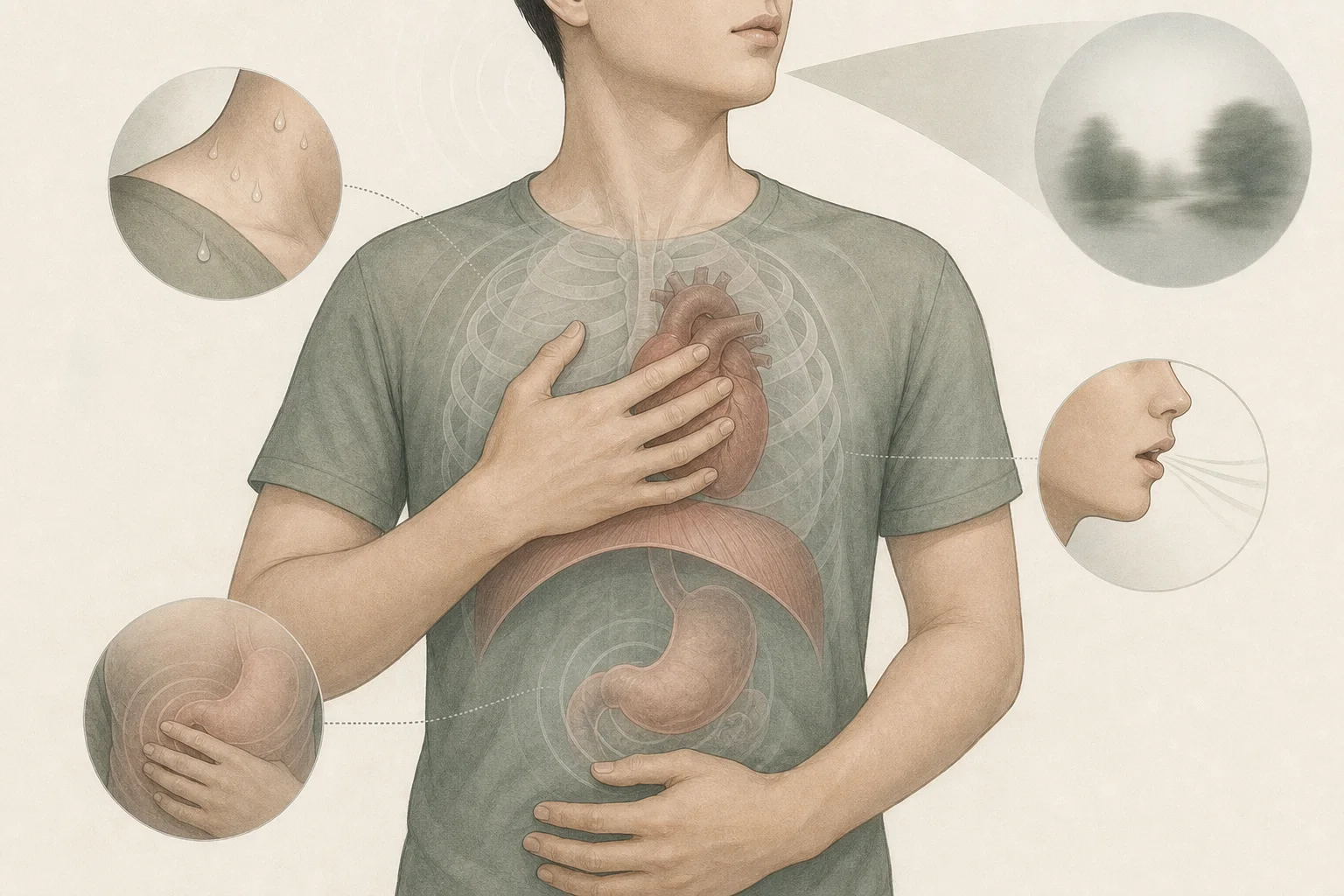
The physical symptoms felt during an attack are real. If new chest pain or fainting occurs, the causes related to the heart and respiratory system should be checked first.
In agoraphobia, the difficulty of escape and receiving help is central, even without attacks
Agoraphobia is not a disease of fearing only wide-open spaces. The core is the feeling that it would be difficult to escape or receive help when becoming uncomfortable in situations such as public transportation, standing in line, enclosed spaces like theaters or elevators, being in a crowd, or being alone outside the home.
It often begins after a panic attack, but it can occur even if attacks are not distinct. If you only go out with a companion, sit only in seats near the exit, and your range of movement decreases, then avoidance must be the center of treatment, regardless of the number of attacks.
In social anxiety, the gaze and evaluation of others make the body freeze
Not only in situations where you are the center of attention, such as presentations or interviews, but also when talking to strangers or eating and writing in front of others, your face may flush, hands may shake, and your mind may go blank. The core is not the location, but the fear of evaluation, the fear of being embarrassed or appearing inadequate.
Social AnxietyWorry often lasts long before the situation occurs, and rumination, reviewing one's words and expressions, tends to continue after the event. If only sudden attacks like panic are treated, the time spent feeling tense in advance, self-censorship, and avoidance of relationships may remain.
Korean medicine treatment distinguishes between combinations of attacks, heat sensations, phlegm-qi, and deficiency
For those experiencing a feeling of blockage in the chest and throat, frequent sighing, or significant tightness in the solar plexus, we focus more on Qi stagnation and phlegm-fluid accumulation. For those with facial flushing, sweating, dry mouth, and insomnia, we focus more on internal heat (ulhwa) and ascending heat. If you are easily startled by small stimuli, experience prolonged exhaustion after an attack, and suffer from decreased appetite and energy, a treatment direction to supplement heart-gallbladder deficiency and Qi-blood deficiency is necessary.
Herbal medicine treatment is formulated to lower the combination of pulsating sensations, respiratory distress, gastrointestinal issues, and sleep disturbances that surge together, and to accelerate recovery after an attack. Acupuncture treatment releases tension in the neck, chest, and diaphragm and eases shallow breathing to reduce the time it takes for the body's alarm system to subside, creating the physical capacity to continue cognitive behavioral therapy and exposure therapy.
The goal of treatment is not 0 anxiety, but a daily life where you can make choices again
Key changes include whether panic attacks no longer peak as intensely and recovery becomes faster for panic disorder, whether the range of movement without a companion expands for agoraphobia, and whether necessary conversations and meetings are no longer avoided for social anxiety.
Symptoms that require separate evaluation to identify physical causes, such as first-time fainting, chest pain during exercise, irregular heartbeat, thyroid issues, or hypoglycemia, are assessed independently. If anxiety and avoidance persist after that, we divide the roles of psychological/drug therapy and Korean medicine treatment to recover from attacks, sleep, digestion, and the range of daily activities within a single integrated plan.
Panic disorder fears the recurrence of attacks, agoraphobia fears the difficulty of escape and receiving help, and social anxiety fears the evaluation of others. Baekrokdam categorizes Qi stagnation, phlegm-fluid accumulation, ascending heat, and Qi-blood deficiency to reduce the intensity of physical attacks and recovery time through herbal medicine and acupuncture, helping patients regain their range of movement and social interaction.
Evidence and Update Information
This content was organized by Korean medicine doctor Choi Yeon-seung based on the materials below and was updated on 2026-08-31.
- NIMH: Panic DisorderDistinction between panic attacks, panic disorder, and agoraphobia, and basic principles of treatment
- NIMH: Social Anxiety DisorderEvaluation of fear and avoidance, physical symptoms, and psychological/drug therapy
- NIMH: Anxiety DisordersSymptoms of anxiety disorders and loss of daily functioning
- NICE CG113: Panic disorder and generalised anxiety disorderEvaluation and step-by-step treatment of panic disorder
- NICE CG159: Social anxiety disorderEvaluation of social anxiety and treatment centered on cognitive behavioral therapy
- PubMed: Acupuncture for AnxietySynthesis of randomized trials and research heterogeneity of acupuncture treatment for anxiety
- WHO: Anxiety disordersPhysical, cognitive, and behavioral symptoms of anxiety and loss of function that may appear alongside OCD